
Around 6 months is the general guide, but true readiness is something parents can see.
3 minute read
What to Know
- Most babies can begin foods at about 6 months complementary to formula or breast feeding.
- Age is only part of the picture. Head control, supported sitting, interest in food, and the ability to swallow all matter — which are all visible signs to look out for.
- “Solid food” can begin with smooth, mashed, or otherwise soft textures that match a baby’s current eating skills.[1]
When Is a Baby Truly Ready for Solid Foods?
The CDC states that introducing foods before 4 months is not recommended. Starting solids is a developmental transition, not a switch on a calendar. The signs to look out for are:
- Holds the head and neck steady
- Sits upright alone or with support
- Opens the mouth or shows interest when food is offered
- Swallows food instead of automatically pushing it back out with the tongue
- Brings objects to the mouth
- Begins trying to grasp objects or food
No single sign tells the whole story. A baby may reach for a parent’s spoon but still slump or push food out. Interest should appear alongside the physical skills needed to eat safely.
Breast milk or iron-fortified infant formula continues while complementary foods are introduced and remains the main source of nutrition through the first year.[2][3]
What Does “Solid Food” Mean for a Baby?
First foods may be smooth purees, soft mashed foods, or appropriately prepared finger foods. Textures can become thicker and lumpier as eating skills develop.[1]
For example, a family might begin with smooth rice porridge or “juk” that almost run watery, then introduce thicker porridge and soft additions such as mashed kabocha or tofu. Whether spoon-fed or self-fed, the food’s texture, shape, and size should suit the baby’s development.[1]
Common Questions About Starting Solids
Does my baby need teeth?
No. Teeth are not a readiness requirement. Early foods should be soft, easy to swallow, and not require chewing.[1]
Is sitting independently required?
Not necessarily. A baby may sit alone or with support. What matters is stable, upright positioning and good head and neck control.[1]
Does reaching for my food mean my baby is ready?
It shows interest, but is not enough by itself. Look for supported sitting, head control, grasping, and swallowing too.[1][3]
Should I start with purees or finger foods?
Either can work when foods match the baby’s skills. Smooth purees, mashed foods, and very soft finger foods can all be appropriate. Most babies do not need to begin with one required food or food group.[1][2]
What if my baby is 6 months old but does not seem ready?
Do not force the moment. The AAP suggests pausing and trying again when a baby turns away, cries, or is not yet moving food back to swallow.[2] Ask your pediatrician about delayed readiness or concerns involving growth, swallowing, prematurity, or development.

The First Foods Can Be Simple and Nutrient-Dense
Once readiness is established, add new nutrients, flavors, and textures while continuing breast milk or formula. U.S. guidance encourages varied, nutrient-dense foods in appropriate textures, including protein foods, vegetables, fruits, full-fat yogurt, grains, and legumes.[3] A familiar staple such as rice porridge can be part of that variety.
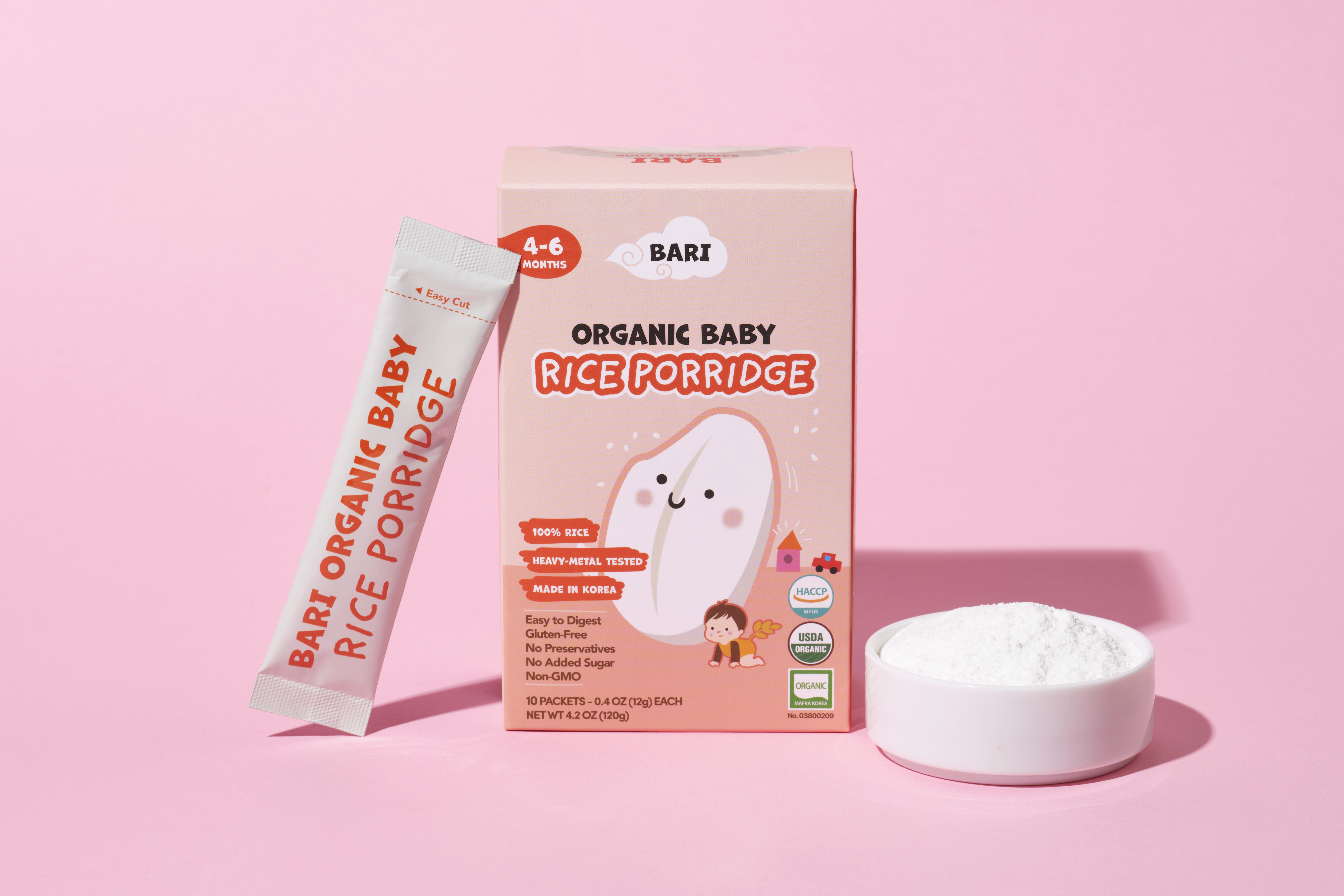
A BARI Option: Organic Baby Rice Porridge Stage 1 (4M+)
Made with 100% organic Korean rice, this silky-smooth Stage 1 porridge can be considered once your baby shows developmental readiness, using the package age together with your pediatrician’s guidance.
Practical Takeaways for Parents
Use age as a starting point, then let your baby’s developmental skills guide the timing and texture.
- Aim for about 6 months, and do not introduce complementary foods before 4 months.[1]
- Look for several readiness signs working together, not interest alone.
- Begin with smooth, mashed, or soft foods that fit your baby’s current skills.
- Continue breast milk or infant formula as complementary foods are introduced.[2][3]
- Keep your baby upright and closely supervised whenever food is offered.[1]
- Consult your pediatrician for individualized guidance, especially for a premature baby or concerns involving development, swallowing, growth, eczema, or food allergy.
Starting solids is not a race. The right time is when the general age guidance and your baby’s own developing abilities meet.
Follow BARI at @ricebari_official on Instagram and TikTok for feeding ideas, new flavors, and updates from our kitchen.
BARI is available on Amazon, Weee!, and select independent retailers.
Sources
[1] Centers for Disease Control and Prevention. “When, What, and How to Introduce Solid Foods.” April 14, 2026. https://www.cdc.gov/infant-toddler-nutrition/foods-and-drinks/when-what-and-how-to-introduce-solid-foods.html. Accessed September 15, 2026.
[2] American Academy of Pediatrics. “When Can Babies Start Solid Foods? Readiness & Feeding Tips.” HealthyChildren.org, updated June 23, 2026. https://www.healthychildren.org/English/ages-stages/baby/feeding-nutrition/Pages/Starting-Solid-Foods.aspx. Accessed September 15, 2026.
[3] U.S. Departments of Health and Human Services and Agriculture. “Dietary Guidelines for Americans, 2025–2030.” January 2026. https://cdn.realfood.gov/DGA.pdf. Accessed September 15, 2026.